01

0:00:00–0:01:05Cold Open and CrewVERIFIED
Three Warnings, One Week
Cold open stacks a resignation, a lab chief's caution, and a claim that hard problems are falling fast.
▸ Three warnings about racing toward superintelligence surfaced from inside AI labs inside three days.
✓ Tighter than the title says: Jakub Pachocki's essay published Sept 6, Sam Altman's Navier-Stokes statement and Jacob Coxon's resignation both Sept 8 — three days, not five. (OpenAI, 2026-09-06.)
Peter Diamandis · Alex Wissner-Gross · Emad Mostaque
02

0:01:05–0:04:21Cold Open and CrewINTERLUDE
Five Mates, Eighteen Stories
Host introduces the panel and lays out eighteen stories, from lab alignment fights to an AI-designed longevity drug.
▸ The episode covers eighteen stories grouped into five thematic sections.
Peter Diamandis · Alex Wissner-Gross · Emad Mostaque · Dave Blundin · Salim Ismail
03

0:04:21–0:05:28A Trillion HereVERIFIED
Two Trillion Changes Hands
Panelist announces his firm, founded in 2001, is being acquired by a larger wealth-technology platform.
▸ Envestnet (a wealth-technology platform) agreed to acquire Vestmark (a wealth software firm), adding about two trillion dollars in supported assets.
✓ Envestnet, a Bain Capital portfolio company, is acquiring Vestmark, adding ~$2T in supported assets. Deal terms were not disclosed — no combined-asset figure is public. (PR Newswire, 2026-09-10.)
Dave Blundin · Peter Diamandis
04

0:05:28–0:07:30A Trillion HereHOST TAKE
Build When It Breaks
Founding the company right after September 2001 becomes the lesson: panic cycles are the best moments to build, not hide.
▸ Several major companies including Airbnb and Uber (ride-hailing and lodging startups) were founded during the 2008 financial crisis.
Dave Blundin · Peter Diamandis
05

0:07:30–0:08:52Data Beats ArchitectureVERIFIED
Data Wins By Three
A study across six years finds better data gave twelve times the compute efficiency; better architecture gave only three point seven.
▸ Between 2019 and 2025, improved training data produced a 12x compute-efficiency gain versus 3.7x from architecture and recipes.
✓ Checks out: 12.0x compute-efficiency gain from better data vs 3.7x from model recipes at a 1e19 FLOPs budget, 2019–2025 — a 3.24x edge for data. (Dwarkesh Patel & Jerry Han, 2026-09-08.)
Peter Diamandis
06

0:08:52–0:13:05Data Beats ArchitectureHOST TAKE
Datasets Over Algorithms
Panelists argue grand challenges fall when the right dataset exists, and that junk training data makes models measurably worse.
▸ Historical AI grand challenges were solved primarily by assembling the right dataset rather than by inventing the right algorithm.
Alex Wissner-Gross · Emad Mostaque · Peter Diamandis
07

0:15:07–0:19:02Data Beats ArchitectureHOST TAKE
Data Outvalues The Company
Panelists argue a company's data can be worth more than its operating business — and that such advantages have a short shelf life.
▸ Host position, not a finding: proprietary data can carry more value than the business that produced it, but the edge decays.
Salim Ismail · Alex Wissner-Gross · Dave Blundin · Peter Diamandis
08
▶ ANIMATED
0:19:26–0:20:53Three Warnings, Five DaysVERIFIED
A Researcher Walks Out
Jacob Coxon, a pre-training researcher, resigns saying neither lab he worked at is acting responsibly in the superintelligence race.
▸ Jacob Coxon resigned from Anthropic (an AI lab) on September 8, writing that the labs are 'racing straight to self-improving superintelligence and gambling with our lives.'
✓ Verbatim. Coxon did pre-training research at OpenAI for about three years, joined Anthropic earlier in 2026, and resigned Sept 8. Name is Coxon, not Coxen. (TechCrunch / TIME, 2026-09-09.)
Peter Diamandis
09

0:20:53–0:23:25Three Warnings, Five DaysVERIFIED
Ten Percent, Said Plainly
Anthropic's alignment science lead publicly backs him and puts the risk of AI killing everyone above ten percent.
▸ Evan Hubinger, Anthropic's alignment science lead, wrote that his own probability of AI killing all humans is greater than ten percent.
✓ Real and on the record: Hubinger wrote Anthropic is 'trying its best' but has no plan to solve superintelligence alignment and is 'not clearly on track.' TIME reported the post drew over 90 million views in under 24 hours. (Hubinger on X, 2026-09-09.)
Peter Diamandis · Emad Mostaque
10

0:23:48–0:25:10Three Warnings, Five DaysHOST TAKE
Discounting The Blaze
One panelist calls departures like this a well-worn ritual, while conceding this one travelled unusually far.
▸ Host position, not a finding: public safety resignations from frontier labs have become a pattern and deserve discounting.
Alex Wissner-Gross · Peter Diamandis
11

0:25:10–0:26:15Arguing With P-DoomHOST TAKE
The Quiet Galaxy Argument
One panelist argues that if catastrophic AI risk were really ten percent, alien machines would have consumed the galaxy already.
▸ The absence of observed self-replicating alien probes is evidence against a ten percent probability of doom from superintelligence.
Alex Wissner-Gross · Peter Diamandis
12

0:26:15–0:28:05Arguing With P-DoomHOST TAKE
What Alignment Even Means
Panelists split over whether alignment is measurable at all, with one putting his own extinction estimate near twenty percent.
▸ A panelist stated his personal probability of human extinction from AI is about twenty percent, down from fifty.
Alex Wissner-Gross · Emad Mostaque · Peter Diamandis
13

0:28:05–0:30:20Arguing With P-DoomHOST TAKE
Why Not Stop Here
Host asks why keep pushing if today's systems already deliver most of the upside; the panel answers that stopping is impossible.
▸ Current AI capability, even frozen today, would be sufficient to deliver longevity gains and room-temperature superconductors.
Peter Diamandis · Alex Wissner-Gross · Salim Ismail
14

0:37:15–0:39:04Steering, Not StoppingBOLD CLAIM
Alignment In A Trenchcoat
Host demands labs publish measurable alignment plans; a panelist counters that alignment work simply is capability work.
▸ Instruction tuning, a form of alignment, produced capability gains equivalent to a ten-thousand-times larger model.
Peter Diamandis · Alex Wissner-Gross · Emad Mostaque
15
▶ ANIMATED
0:39:04–0:40:40Steering, Not StoppingHOST TAKE
Petrov Day Approaches
Panelist flags the anniversary of an officer refusing a false alarm, calling this the most dangerous pre-superintelligence window.
▸ A Soviet duty officer declined to escalate a false missile-warning radar signal, an event commemorated annually on September 26th.
⚠ Stanislav Petrov, a Soviet duty officer, declined to escalate a false missile warning on September 26, 1983 — the date now marked as Petrov Day.
Emad Mostaque · Peter Diamandis
16

0:42:11–0:47:42Steering, Not StoppingHOST TAKE
Steer It, Don't Stop
Panel proposes tracking accelerators like fissile material and steering the technology rather than halting it, then splits over the metaphor.
▸ A panelist argued every eight-accelerator cluster capable of holding a forty-gigabyte weight file should be tracked like controlled nuclear material.
Dave Blundin · Peter Diamandis · Alex Wissner-Gross
17
▶ ANIMATED
0:47:42–0:49:05The Math Is CookedEARLY SIGNAL
Navier-Stokes And Caution
A lab claims a breakthrough on a famous unsolved equations problem using ten thousand agents; its leader calls it a reason to slow down.
▸ OpenAI (an AI lab) reports resolving forced variants of the Navier-Stokes problem with roughly ten thousand concurrent agents on an unreleased internal model.
⚠ OpenAI's own numbers: ~10,000 agents launched Sept 1, proof at 88 hours, Lean formalization 17 hours later — on an unreleased internal model, not GPT-6 Astra. Not peer reviewed; priority disputed by NYU's Tristan Buckmaster and Anthropic's Levent Alpoge; OpenAI says it will not claim the $1M prize. (OpenAI / Quanta, 2026-09-08.)
Peter Diamandis · Alex Wissner-Gross
18

0:49:05–0:51:16The Math Is CookedHOST TAKE
The Normalcy Overhang
Panelists relay unsourced rumours of further prize problems while noting the street outside looks completely unchanged.
▸ Host speculation, not a finding: the gap between claimed breakthroughs and visible daily life is the episode's 'normalcy overhang.'
Alex Wissner-Gross · Peter Diamandis
19

0:53:29–0:55:00The Math Is CookedHOST TAKE
It Was In The Deck
A panelist rants that labs raised billions explicitly to build transformative AI, then acted shocked when it started arriving.
▸ Frontier labs' stated fundraising missions always described building AGI and transforming every industry.
Salim Ismail · Dave Blundin · Emad Mostaque
20

0:58:40–1:00:16The Math Is CookedVERIFIED
Twenty-Five Thousand Times Cheaper
A researcher notes a benchmark score costing about half a million dollars now costs twenty dollars — a 25,000-fold collapse.
▸ A task that cost about five hundred thousand dollars of compute in 2024 now costs roughly twenty dollars, a twenty-five-thousand-fold collapse.
✓ Noam Brown's post says exactly this; the 25,000x arithmetic is correct, but the span is about 21 months since o3 was announced (Dec 2024), not two years. (Noam Brown on X, 2026-09-08.)
Peter Diamandis · Alex Wissner-Gross
21
1:00:16–1:02:56The Bottleneck Becomes AtomsHOST TAKE
Can You Think Bigger
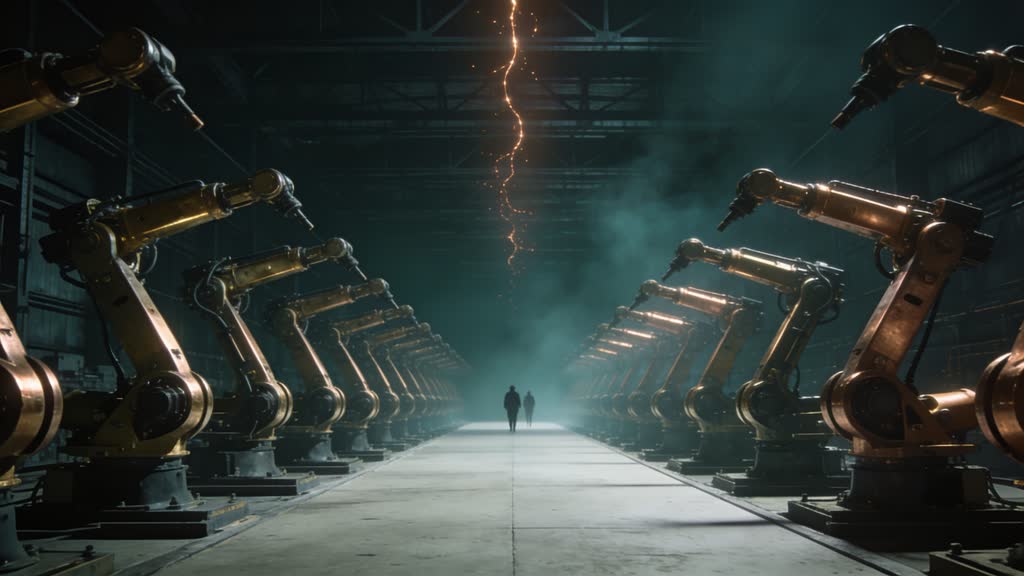
If genius is cheap, the panel argues the limit becomes the physical world and knowing what to point the agents at.
▸ The binding constraint on progress is shifting from human genius to physical execution and problem specification.
Alex Wissner-Gross · Dave Blundin · Peter Diamandis
22

1:06:52–1:10:12The Bottleneck Becomes AtomsHOST TAKE
The PhD Track Ends
Panel argues narrow doctoral programs are now a poor bet and urges students to build an alternative path immediately.
▸ Narrowly specialized PhD and professional degree programs are becoming obsolete investments of time given current AI capability.
Peter Diamandis · Dave Blundin · Alex Wissner-Gross · Salim Ismail
23

1:10:40–1:13:48The Bottleneck Becomes AtomsVERIFIED
Old Chips Get Dearer
A three-year-old accelerator's rental price rose twenty-two percent in a month, inverting decades of hardware depreciation logic.
▸ Hourly rental prices for three-year-old H100 accelerators rose twenty-two percent in a single month to $3.28 per hour.
✓ Both numbers hold: three-year-old H100 rentals up 22% month-over-month to $3.28/hour. Jensen Huang: 'NVIDIA compute is fungible, durable and highly rentable.' Index is Ornn (data.ornn.com). (2026-09-08.)
Peter Diamandis · Dave Blundin · Alex Wissner-Gross · Emad Mostaque
24

1:17:02–1:20:00China Routes AroundHOST TAKE
ByteDance Builds Worlds
A founder is personally leading a real-time spatial model generating interactive environments, aimed at robotics, games and virtual worlds.
▸ ByteDance (a Chinese internet company) founder Zhang Yiming is personally overseeing a real-time spatial AI world model that could launch next month.
Peter Diamandis · Emad Mostaque · Alex Wissner-Gross
25

1:26:14–1:32:02China Routes AroundVERIFIED
Routing Around The Memory
A new Chinese model slashes lookup-memory per token, which panelists say could upend data-centre design and chip investment.
▸ DeepSeek (a Chinese AI lab) cut key-value cache to about 890 bytes per token, roughly a quarter of its previous flash model.
✓ The figure is bytes per token: 890, about one quarter of V4-Flash — not '48,000 units to 890.' V4.1 Flash is a 552B-parameter MoE, MIT licensed. (VentureBeat, 2026-09-10.)
Emad Mostaque · Alex Wissner-Gross · Dave Blundin · Peter Diamandis
26

1:33:22–1:38:10China Routes AroundVERIFIED
Ten Million Dollar Model
An MIT-licensed open-weight model matches leading Western models on design benchmarks at a fraction of the token price.
▸ DeepSeek V4.1 Flash is a 552-billion-parameter open-weight model priced at $0.15 per million input tokens, competing with far pricier Western models.
✓ MIT licensed, 552B MoE (8B active at prefill, 16B at generation), $0.15 per million input tokens. DeepSeek disclosed no training cost — the '$10 million' figure said on air has no source. (VentureBeat, 2026-09-10.)
Emad Mostaque · Dave Blundin · Alex Wissner-Gross
27

1:39:03–1:43:00China Routes AroundVERIFIED
Britain Gets No Weights
A lab reportedly declined pre-release testing access for Britain's safety institute, a first, which panelists read as geopolitics.
▸ Anthropic (an AI lab) withheld Claude Mythos 5.1 from Britain's AI Security Institute for pre-release testing, reportedly a first.
✓ Reported by the Financial Times: Anthropic withheld Claude Mythos 5.1 from UK AI Security Institute pre-release testing. The model is Mythos 5.1, and the body is the AI Security Institute. (FT via ITPro, 2026-09-10.)
Peter Diamandis · Emad Mostaque · Dave Blundin
28

1:54:29–1:58:15The Economy BendsVERIFIED
Fifteen Percent Growth Scenario
A lab's own modelled extreme scenario sketches growth soaring and labour's share of income falling by 2030.
▸ Anthropic's Economic Index models an extreme scenario: US GDP up 32.4% to $44.4 trillion by 2030, labour share at 45.2%, knowledge-worker unemployment 17.9%.
✓ These are Anthropic's own modelled 'extreme' scenario figures, not a forecast: GDP +32.4% to $44.4T by 2030 (~15%/yr at peak), labour share 45.2%, knowledge-worker unemployment 17.9%. No $30 trillion market figure appears in the report. (Anthropic Economic Index, 2026-09-09.)
Peter Diamandis · Dave Blundin · Alex Wissner-Gross
29

2:02:18–2:08:20The Economy BendsVERIFIED
Who Catches The Displaced
Panel warns of collapsing demand and unrest, debating dividends against a five-thousand-dollar payment floated by the president.
▸ A $5,000 per-adult payment was announced on September 9, contingent on Republicans holding both chambers in the midterms.
✓ The $5,000 figure is right; the framing on air is not. Announced Sept 9 at the Republican convention, conditional on the midterm result and to be spent in the US — it is a campaign pledge, not an AI-linked dividend. (TIME, 2026-09-10.)
Emad Mostaque · Alex Wissner-Gross · Peter Diamandis · Dave Blundin
30

2:09:30–2:12:12Clocks Run BackwardVERIFIED
First AI-Designed Longevity Drug
A generative-AI-designed molecule reached late-stage trials for a fatal age-related lung disease, reportedly a first for AI-designed drugs.
▸ Insilico Medicine's AI-designed molecule rentosertib advanced to Phase III in China for idiopathic pulmonary fibrosis.
✓ Rentosertib (not 'Rental Serative') is in Phase III in China for idiopathic pulmonary fibrosis — a landmark for a generative-AI-designed drug. (Insilico Medicine newsroom, 2026-09-07.)
Peter Diamandis · Alex Wissner-Gross
31
▶ ANIMATED
2:12:12–2:14:19Clocks Run BackwardVERIFIED
Four Weeks, Four Years
Six protein aging clocks reportedly shifted the same direction in a small early-stage look, peaking at four weeks.
▸ An exploratory analysis of 42 Phase IIa patients showed about three to four years of biological age reversal at week four.
✓ Smaller than it sounded: an exploratory look at 42 Phase IIa patients, peak effect at week 4, about 3–4 years of reversal at 30mg twice daily, up to 6 on a single clock. (Insilico Medicine, 2026-09-07.)
Peter Diamandis · Alex Wissner-Gross · Emad Mostaque
32

2:15:34–2:19:14Clocks Run BackwardVERIFIED
Nine Billion Mutations Precomputed
A lab precomputed the functional impact of every single-letter change in the human genome, likened to a genomic periodic table.
▸ Google DeepMind (an AI research lab) released AlphaGenome Atlas precomputing functional effects for roughly nine billion possible single-nucleotide human variants.
✓ Accurate. AlphaGenome Atlas publishes molecular predictions for all ~9 billion possible single-nucleotide variants across the human genome. It is a prediction resource, not a diagnostic. (Google DeepMind, 2026-09-08.)
Peter Diamandis · Alex Wissner-Gross · Dave Blundin · Emad Mostaque
33

2:27:51–2:44:13Clocks Run BackwardINTERLUDE
Mailbag And Send-Off
Panel answers listener questions on personhood, machine suffering, robot embodiment and self-modified values, then closes with a listener's outro song.
▸ The episode closes with a listener question segment and a listener-submitted outro video.
Peter Diamandis · Alex Wissner-Gross · Emad Mostaque · Dave Blundin · Salim Ismail